| |
|
The emergence of Generative Artificial Intelligence (GenAI) has rapidly reshaped the education landscape. A subset of artificial intelligence (AI), GenAI learns from vast amounts of existing data to produce novel yet similar content, including text, images, music and videos. Two prominent examples of GenAI are ChatGPT and DALL.E, which create text and images based on user prompts, respectively. The United Nations Educational Scientific Cultural Organization (UNESCO) strongly believes that AI has the ability to fast-track the achievement of SDG 4, which promotes “inclusive and equitable quality education” by addressing critical issues in education and innovating teaching and learning methods. However, any form of development or revolution would be accompanied by a host of risks and challenges. Empathetic towards this fact and the welfare of its member states, UNESCO has developed several frameworks to address the needs and questions of various stakeholders within the field—students, educators, administrators, researchers and policymakers (UNESCO, 2023).
|
| |
Fears and Challenges
|
| |
|
This rise of GenAI gained significant traction in Asia with the advent of ChatGPT in late 2022, sparking immediate widespread concern among educators. Many viewed this technology as a threat rather than an opportunity. Educators were primarily concerned that students would exploit these tools, undermining the learning processes. According to UNESCO (2023), the following challenges have been identified regarding the implementation of AI in education:
|
| |
- Ethics: There are risks of plagiarism and other forms of academic misconduct; the learning processes may be undermined, and critical thinking skills may suffer as students become overly reliant on AI-generated content.
- Data Privacy and Security: The collection and processing of sizable volumes of data lead to privacy breaches and unauthorised access to sensitive information.
- Bias and Fairness: Biases in training data may result in discriminating or unfair outcomes.
- Regulatory Unpreparedness: The lack of regulations, policies, and other governing frameworks in many countries may hinder the effective and ethical implementation of the technology.
- Digital Divide: Existing disparities in education may be exacerbated, further affecting underprivileged and marginalised communities.
- Training and Professional Development: Educators and school administrators lack the necessary skills to use or integrate AI in their daily work and teaching practices.
- Output Quality and Authenticity: Inaccurate, exaggerated, misleading or superficial AI-generated output may negatively impact the quality of research, education and training.
|
|
|
| |
| |

|
| |
| |
|
Locally, many educators resisted the use of GenAI because of its potential to facilitate plagiarism and other forms of academic dishonesty. In response to this concern, many actively discouraged its use and sought ways to deter students from leveraging these tools in their academic work. Some educators turned to detection tools like Turnitin, GPTZero and Copyleaks to identify and penalise the use of GenAI in academic writing. However, their efforts quickly became futile as tools and applications to humanise AI-generated content continued to evolve at an astonishing rate, outsmarting humans and outpacing existing technologies. Furthermore, some detection tools themselves reported peculiar results and false positives, rendering their effectiveness unclear. A small fraction of traditional educators remained unperturbed by GenAI’s developments, hoping that the hype would soon fade away along with the technology. This resistance is at odds with the evolving discourse surrounding AI literacy, which is progressively shifting towards the concept of AI fluency.
|
| |
Potential and Strategies to Mitigate
|
| |
|
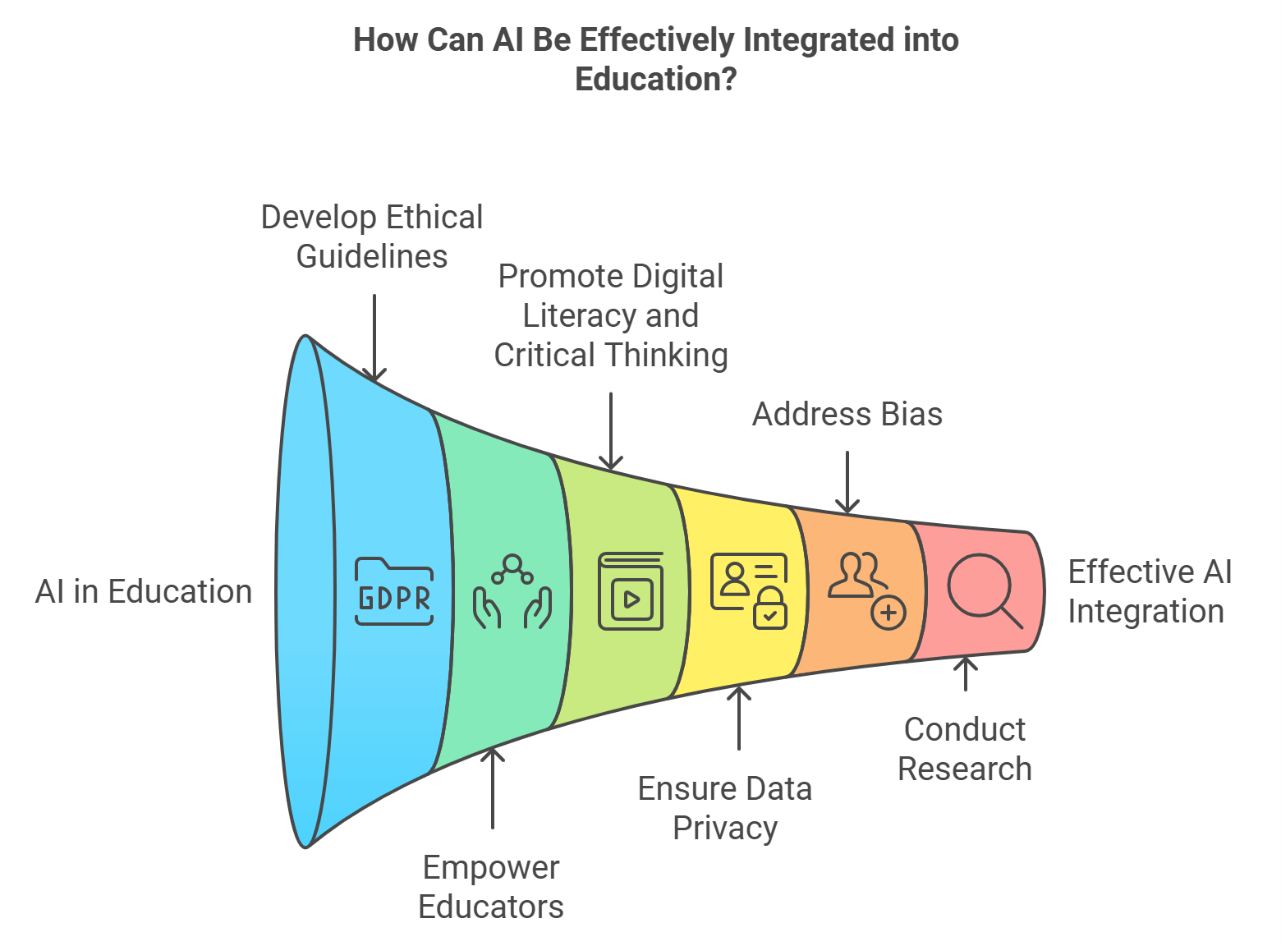
As we approach the end of 2024, the use of GenAI and AI technologies at large has only multiplied, evolving astronomically and expanding into various sectors beyond education. Increasingly, more individuals recognise these technologies as tools that enhance productivity, foster innovation, and facilitate workflows. Within the education sector, an increasing number of educators are coming to terms with the reality that GenAI is not a passing phenomenon. They are actively seeking to understand its use, if not embracing it in their daily work and teaching practices. According to UNESCO (2023), several key strategies are crucial for the effective integration of AI in education:
|
| |
- Develop Ethical Guidelines and Policies: Establish clear guidelines and policies that can govern the responsible and effective use of GenAI in education. These should realistically define acceptable use, ensure academic integrity and safeguard against malpractice.
- Empower Educators through Training and PD: Implement comprehensive training that would equip educators with the knowledge and skills needed to understand AI capabilities, address ethical challenges and reinvent teaching strategies that are pedagogically sound and AI-savvy.
- Promote Digital Literacy and Critical Thinking: Incorporate digital literacy and critical thinking skills into the curriculum and guide students to become responsible and effective users of GenAI.
- Ensure Data Privacy and Security: Adopt robust data protection measures to safeguard sensitive information. Ensure compliance with data privacy regulations and employ secure data handling practices.
- Address Bias and Promote Fairness: Develop and deploy GenAI systems that are transparent, fair and bias-free by using diverse, representative datasets and regularly auditing AI models for discriminatory outcomes.
- Conduct Research: Support continuous research and evaluation activities to assess the impact of GenAI and develop evidence-based strategies to integrate it into education.
|
|
|
| |
| |
|
| |
| |
Right Mindset
|
| |
|
The core issue lies in people’s mindset or perception of the technology. Is the technology used as a self-substitute or as a supportive tool? It is crucial that AI users, both educators and students alike, understand how to use GenAI appropriately and responsibly. When used correctly, GenAI can become invaluable. It saves time, increases productivity and enhances effectiveness. However, over-dependence on these tools can hinder learning, and impede one’s personal development and cultivation of real abilities.
Educators must first familiarise themselves with the technology, test its capabilities, and identify its potential applications within their specific fields. By exploring its strengths, weaknesses, opportunities, and challenges, educators will be better equipped to model best practices for their students, teaching them how to use these tools responsibly while upholding academic integrity.
Moreover, as educators gain experience with GenAI, they must nurture this understanding in their students, encouraging them to remain actively engaged in the learning process. In doing so, students can learn to use GenAI as an academic aid rather than as a substitute for their own efforts.
In summary, the integration of GenAI into education presents a unique set of opportunities and challenges. Educators must approach this technology with an open mind, embrace its potential, and develop a nuanced understanding of how to use it effectively in the classroom. Only through this process can we ensure that GenAI serves as a valuable tool in enhancing education, rather than becoming a source of academic misconduct.
|
| |
| |
Reference:
|
| |
UNESCO. (2023). Guidance for generative AI in education and research.
|
| |